
When words aren’t always enough
One of the questions that has stayed with me throughout my work with trauma is what we can do when words aren’t enough.
Sometimes we don’t have the words for what has happened to us. Sometimes we have them but don’t feel able, or don’t want, to say them. And sometimes we can tell what happened perfectly well, yet something in the present can bring back the emotions, sensations or responses of the original experience, as though part of us is back in those moments again.
This is one of the things that has drawn me towards Eye Movement Desensitisation and Reprocessing (EMDR).
Traumatic experiences aren’t always held in ways that we can consciously remember, understand or put into words. They can also show themselves through emotions, physical sensations, images, beliefs and automatic responses. EMDR offers another way of working with these different aspects of an experience, without therapy necessarily depending upon being able to explain everything in words.
That feels important to me. I’ve never believed that somebody should have to tell me every detail of what has happened to them in order for us to work together. You don’t have to tell me everything that happened for your experience to be real, or for therapy to be meaningful.
The more I’ve worked with trauma, the more I’ve found myself returning to the same question:
What else might be helpful here?
EMDR is one of the places that question has taken me.
So, what actually is EMDR?
EMDR stands for Eye Movement Desensitisation and Reprocessing. Despite the name, there’s considerably more to it than moving your eyes from side to side.
EMDR is a structured therapeutic approach. The work includes understanding what someone is experiencing, preparation, identifying what might be helpful to work with, processing, and making sure that sessions are brought to a safe close.
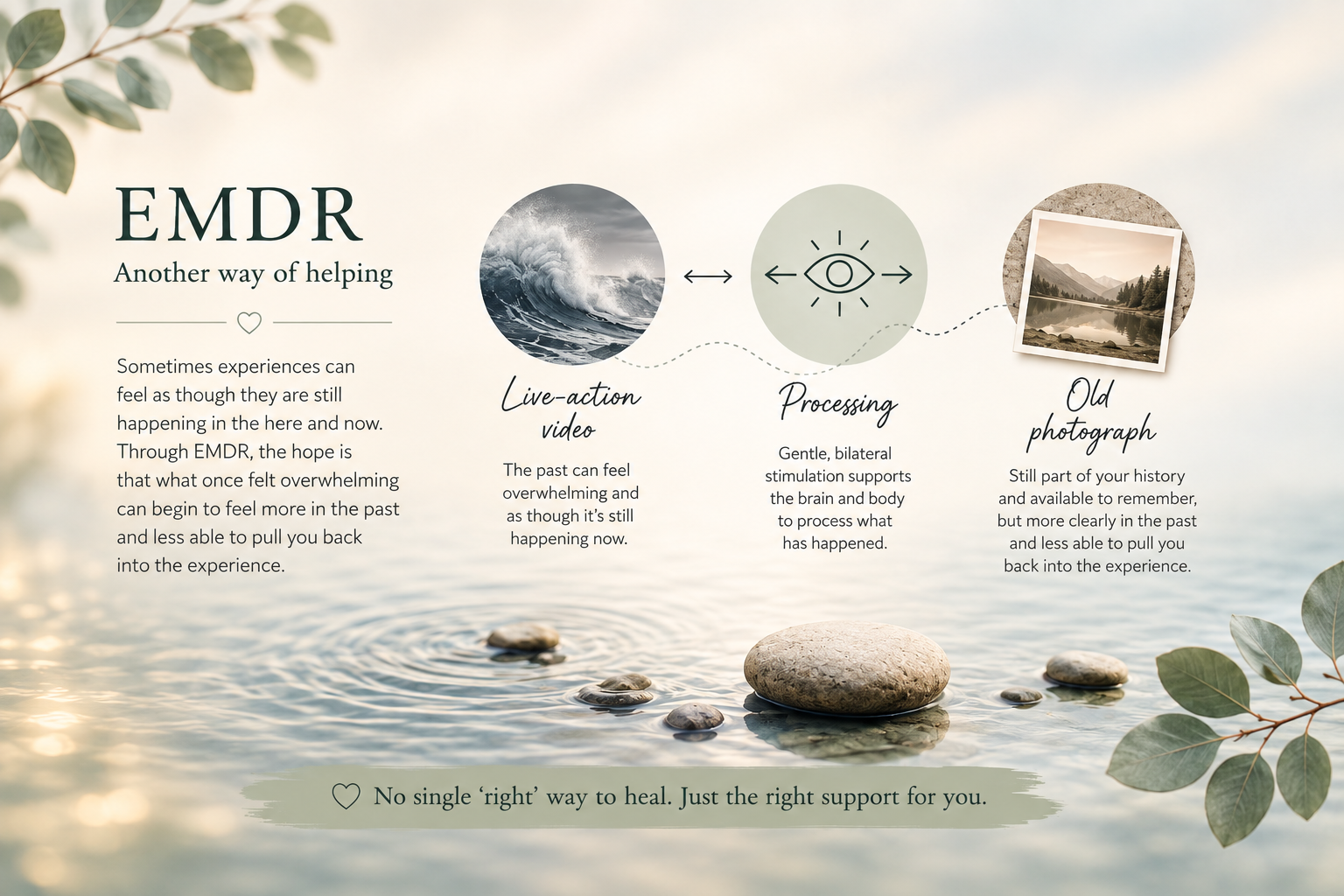
One of the ideas underpinning EMDR is that some experiences can remain insufficiently processed. Something happening in the present may then bring with it emotions, physical sensations, beliefs or automatic responses connected with something that happened in the past, as though part of us hasn’t quite recognised that the danger has passed.
EMDR uses a technique called bilateral stimulation, which simply means creating a repeated left-to-right pattern. In practice, this might involve watching a therapist’s fingers or a light move from side to side, hearing a sound alternately in one ear and then the other, or tapping alternately on the right and left sides of the body, such as the knees.
Although bilateral stimulation can sound rather technical, the experience itself can be surprisingly simple. It forms one part of the wider EMDR process and is used alongside carefully structured therapeutic work to support the processing of distressing experiences.
You may be asked to notice what is happening, perhaps a thought, feeling, image or sensation, but you don’t necessarily need to describe everything you are experiencing aloud. Often, only a small amount of information needs to be shared with the therapist as the processing takes place.
EMDR isn’t about erasing a memory or changing what happened. The past remains part of our history; what we hope can change is how strongly it continues to affect us in the present.
A traumatic memory can sometimes feel less like something that happened in the past and more like a live-action video playing in the here and now — bringing with it the feelings, sensations and responses of the original experience.
Through processing, the hope is that it can begin to feel more like an old photograph: still part of your history and available to remember, but more clearly belonging to the past and less able to pull you back into the experience.
A therapy that continues to develop
One of the things I find particularly interesting about EMDR is that it hasn’t stood still. As our understanding of trauma has developed, clinicians have continued to explore how EMDR can be adapted for the different ways trauma can present. I’m particularly interested in developments around developmental and complex trauma, attachment and dissociation.
Dissociation is especially important to me.
Historically, significant dissociation has been approached very cautiously within EMDR because trauma processing that moves too quickly, or doesn’t recognise dissociation, can potentially overwhelm or destabilise someone. That caution matters.
What I find hopeful is that the conversation is increasingly not simply about whether someone who dissociates can or can’t have EMDR. There is growing attention to how the work can be approached differently: greater preparation, careful pacing, stabilisation, collaboration, attention to different parts of the self, and adapting the work to the individual rather than expecting the individual to fit a standard process.
I’m also excited to learn more over time about attachment-focused approaches to EMDR, particularly where difficult or traumatic experiences happened within relationships or much earlier in life.
None of this means that EMDR will be right for everyone, or that every presentation of trauma or dissociation should be approached in the same way. Quite the opposite. What excites me is the possibility of an approach continuing to grow as our understanding of people grows with it.
The beginning of another journey
There is something about beginning EMDR training that reminds me of first becoming a counsellor.
When I originally qualified, I think part of me imagined that qualification would feel like reaching the end of something. Looking back, I can see that it was really the beginning. Training gave me the foundations, while experience, supervision, further study and, perhaps most importantly, the people I’ve worked alongside have continued to shape the counsellor I am today.
I imagine learning EMDR will follow a similar path.
I will be beginning my formal EMDR training shortly. That initial training will give me the foundations I need to begin developing my EMDR practice, but completing a training course doesn’t instantly create years of experience, and I don’t want to pretend that it does.
I want to learn the process properly, practise carefully, use supervision and allow my confidence and competence to develop with experience. As I begin working with EMDR, I will work within the level of my training and experience. For me, working ethically includes recognising what I know, what I’m still learning and when something requires greater experience or specialist knowledge.
Over time, I’m particularly interested in developing my understanding of attachment, complex trauma and thoughtful approaches to dissociation. But I want to arrive there carefully rather than rushing towards complexity before I have the experience to work with it well.
If EMDR is something we consider using together, I’ll also be open with you about where I am in my training and experience. We can talk about why I think it might be helpful, what it involves and whether it feels like the right approach for you.
Another possibility, not the only answer
I’m not training in EMDR because I think I’ve finally found the answer to trauma. I’m training because I would like to have another way of helping.
Talking and being understood may be exactly what someone needs. Developing an understanding of what’s happening can make an enormous difference. At other times, words aren’t available, aren’t wanted or simply don’t seem to reach the parts of an experience that continue to cause distress.
Having another therapeutic approach available gives us another possibility.
EMDR won’t replace the person-centred values at the heart of how I work. I still believe that therapy should respond to the person rather than asking the person to fit the therapy.
And perhaps that’s what I’m most excited about: not another qualification to add to a list, but another period of learning, questioning, practising and discovering what might be possible.
There is no single “right” way to heal.