
Have you ever reached the end of the day feeling completely exhausted and then wondered what you’ve actually done to be so tired?
Maybe you haven’t been particularly busy. You haven’t run a marathon, climbed a mountain, or even managed half the things you intended to do. Perhaps you’ve spent quite a lot of the day sitting down. And yet somehow, you feel as though you’ve run out of everything.
It can be surprisingly easy to judge ourselves for this. I’ve hardly done anything today. Why am I so tired? I should have more energy than this.
But perhaps the problem is in how we’re measuring “doing something.” We tend to notice the energy we spend on things we can see: working, cleaning, exercising, travelling, looking after children, ticking things off a list. It’s much harder to notice the energy being used internally.
Worrying, concentrating, managing emotions, filtering out what’s happening around us, or simply trying to appear okay can all take energy.
Sometimes, an enormous amount can be happening inside us, even when very little appears to be happening on the outside. So perhaps a more useful question than “Why am I exhausted when I haven’t done anything?” is: “I wonder what has been taking so much energy?”
When your body is working overtime
Sometimes tiredness isn’t just about how much we’ve physically done. Our bodies are continually responding and adapting to what is happening around us, and prolonged periods of stress or alertness can take their toll.
When we’re stressed or anxious, the body can become more prepared for what might happen next. We might notice tension in our muscles, changes in our breathing, a racing heart or that familiar feeling of being slightly on edge. But sometimes it’s much less obvious than that.
We might be constantly checking the mood of the people around us, thinking several steps ahead, preparing for things to go wrong or finding it difficult to properly switch off. For some people, this way of being has become so familiar that they don’t particularly experience themselves as anxious. It just feels normal.
If you’ve spent a long time needing to be alert to what is happening around you, your body may have become very good at it. It isn’t necessarily something you’ve consciously chosen or can simply tell yourself to stop doing, and being prepared all the time can be exhausting.
The work nobody sees
Not all effort looks like effort. Sometimes we’re doing several jobs at once without even realising it.
We’re having a conversation, but we’re also thinking about what to say next, watching the other person’s expression, wondering whether we’ve said too much, trying not to interrupt, working out whether they’re joking, noticing the noise in the room and trying to ignore the uncomfortable chair. Perhaps we’re also trying to look interested while part of our attention has wandered somewhere completely different.
From the outside, we’re just having a cup of coffee with someone. On the inside, it can be surprisingly busy.
The same can happen in lots of ordinary situations. A trip to the supermarket might involve bright lights, music, people moving unpredictably, making decisions, remembering what we came for and navigating the person who has somehow managed to park their trolley diagonally across the entire aisle.
Work might mean concentrating on the job itself while also managing interruptions, expectations, relationships and the effort of appearing composed when we’re struggling. Even being with people we like can take energy. We might be monitoring how we’re coming across, adjusting ourselves to fit the situation, trying to work out what somebody needs from us, or pushing aside our own discomfort because it doesn’t feel like the right time to show it.
Sometimes we’ve been doing these things for so long that we don’t recognise them as effort anymore. We may simply know that other people seem able to do something and carry on with their day, while we need to go home and recover from it.
It might be worth becoming curious about how much work we’re doing that nobody else can see, and perhaps, until now, we haven’t been counting either.
Sometimes it isn’t just about today
We can also make the mistake of measuring our tiredness against what we’ve done that day. But our bodies don’t necessarily start each morning with a completely replenished battery.
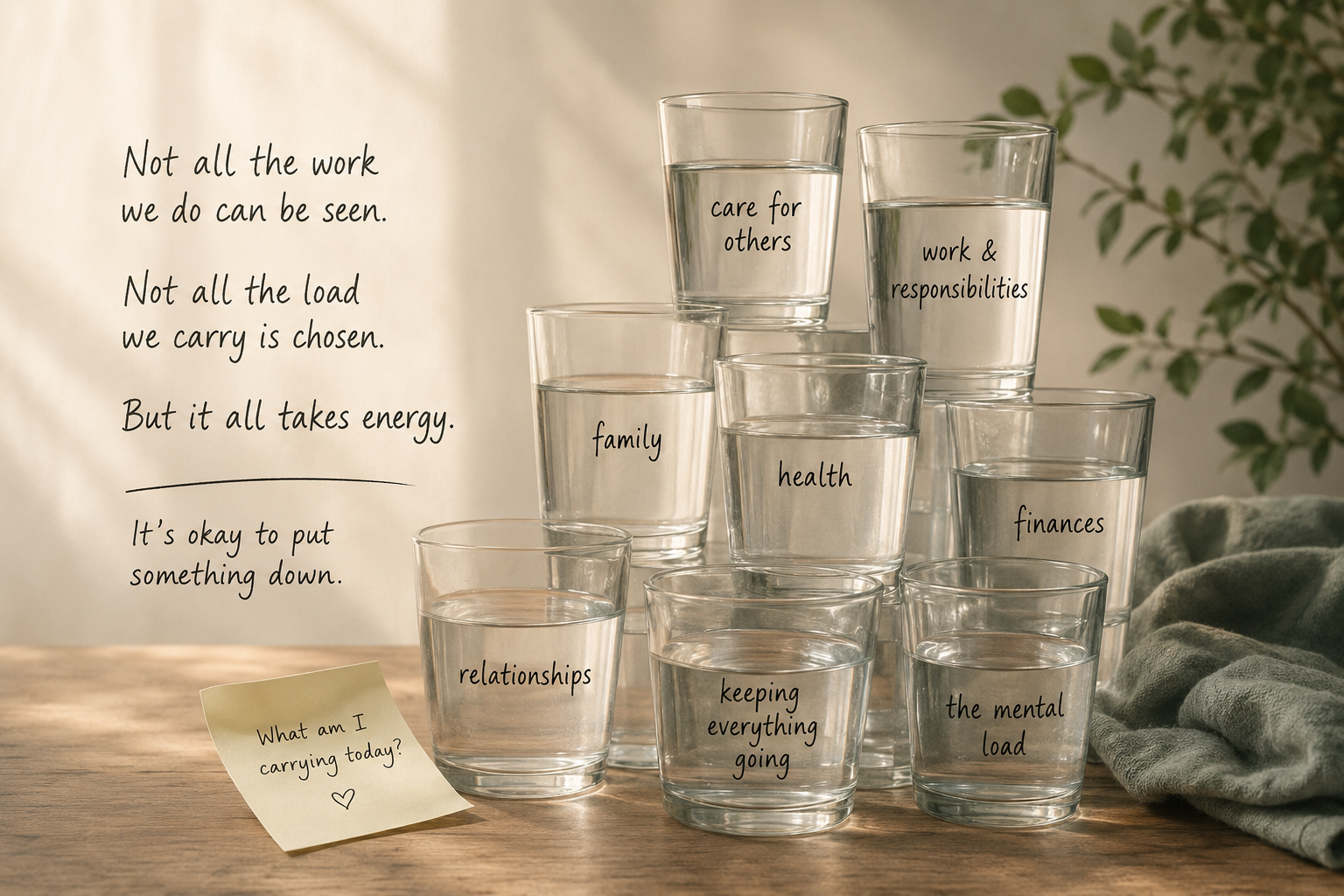
Imagine I asked you to hold out a glass of water. For the first few minutes, it probably wouldn’t be particularly difficult. You might manage half an hour or even an hour. But imagine I asked you to keep holding it for the rest of the day. Then tomorrow. Then next week.
The glass hasn’t become any heavier, but holding it has become harder. Your muscles have grown tired. Maintaining the same position takes more effort. Your attention has been occupied by the need to keep holding on. What was easy for a few minutes becomes exhausting when there is no opportunity to put it down.
Sometimes life can be a little like that. And importantly, we don’t always get to choose the glasses we’re holding.
Some responsibilities are ones we willingly take on. Others arrive through circumstance. We may be caring for somebody because there is nobody else to do it, working because the bills still need paying, carrying more than our share in a relationship or family, or trying to function within environments that ask much more of us than they seem to ask of other people.
Sometimes putting the glass down doesn’t feel possible. Doing so might have consequences for us or for somebody we care about. And sometimes, whether intentionally or not, other people or systems benefit from our ability to keep holding it.
And rarely is there just one glass. Life tends to hand us several: work, family, relationships, money, health, caring for other people, keeping a home running, remembering what needs doing next. Some are heavier than others. Some come and go. Some we’ve been holding for so long that we’ve almost forgotten they’re there.
Every now and then, another glass gets handed to us. We might manage that too. Perhaps we rearrange everything we’re already carrying, grip a little tighter and somehow make room. From the outside, we still appear to be coping. Sometimes being very good at carrying the glasses is precisely why nobody notices how much we’re holding.
Sometimes we’ve carried all of this successfully for years, perhaps even decades. Then something changes, our health, hormones, sleep, circumstances, or simply how much reserve we have left, and suddenly we can’t manage things in quite the same way.
Something starts to spill. We have to put something down, or our arms simply can’t keep doing what they’ve always done. That can be frightening, particularly if we’ve always thought of ourselves as someone who copes. I used to do so much more than this. Why can’t I cope now?
Sometimes it can even be one apparently small thing that feels like the thing that finally tips us over. But maybe it wasn’t really about that last glass. It was simply the one we no longer had a free hand to hold.
So perhaps the question isn’t only “Why can’t I cope with this?” It might also be: “How much am I holding, how long have I been holding it, and when was the last time I was able to put any of it down?”
When rest doesn’t feel restful
Sometimes we do stop. We sit down, clear an afternoon and try to rest. And yet our mind keeps going.
We might be thinking, planning, scrolling, replaying conversations, remembering things we’ve forgotten to do, worrying about tomorrow or bracing for something we can’t quite name. From the outside, it looks like rest. Internally, however, some of the work may still be happening.
That’s one reason rest doesn’t always feel restorative. An afternoon on the sofa can be valuable, but it doesn’t necessarily undo weeks, months or years of running on depleted reserves. And sometimes slowing down gives us our first opportunity to notice just how tired we’ve become.
There can be something particularly confusing about crashing after the difficult period has passed. Perhaps the deadline has been met, the children need us less, we’ve taken time off work, a difficult situation has ended, or things are finally supposed to be easier. And instead of feeling better, we feel exhausted.
It can leave us wondering, Why now?
Sometimes we’ve been so occupied with keeping going that there hasn’t been much room to notice the cost of keeping going. When some of the immediate pressure finally reduces, what we’re left with may include tiredness we hadn’t fully noticed while we were keeping going.
That doesn’t mean we’re doing rest wrong, and it doesn’t mean the answer is simply to become better at relaxing. Perhaps it’s another invitation to become curious: What is still taking energy, even when everything looks still?
Listening to tiredness rather than judging it
None of this means that exhaustion is always psychological. Persistent or unexplained tiredness can have many physical causes. If you’ve been feeling tired for several weeks without knowing why, it’s affecting your daily life, or you have other symptoms that concern you, it’s worth talking to your GP.
Perhaps instead of “I haven’t done anything. I shouldn’t be this tired,” we might ask: What has my body been managing? What has my mind been doing? What have I been carrying? And how long have I been carrying it?
Sometimes tiredness may be telling us something that productivity can’t measure. And perhaps understanding that is a gentler place to begin.